Tomorrow I’m speaking on the subject of laziness @ CCA. Actually, I’m speaking about the sluggard in Proverbs. Don’t you just love that word – sluggard? It sounds like slug, something we know a lot about here in the Northwest. Slugs move slowly; they don’t seem to have much value; they are extremely annoying (especially when they eat your lettuce!). In short, slugs are a lot like sluggards.
In preparation for the sermon, I once again turned to one of my favorite authors, Ben Patterson. He wrote a book called Serving God: the Grand Essentials of Work and Worship. It’s one I’ve turned to often when I’ve given consideration to the theme of work. Patterson reminds us that the Reformers, especially Luther and Calvin, gave a great deal of thought to the subject of vocation. Our English word vocation comes from the Latin root, vocare, meaning “to call.” The Reformers believed that every follower of Christ has a similar vocation, or calling – that is, to glorify Christ as his servants and priests to the world. Luther’s concept of the priesthood of all believers is rooted in this understanding. Every one of us is called to be a minister of Christ– not just a chosen few.
In short, we have differing occupations, but one common vocation. Our skills vary, but the end result of using those skills for God will be very similar – namely, Jesus will end up looking good.
In his book, Patterson cites a poem by the seventeenth century priest George Herbert. Every time I read this poem, it touches something in me. It’s called The Elixir, after the stone that the alchemists in Herbert’s day sought which could supposedly transform common metals into precious ones. In this poem, Herbert applies the idea to our work. What is the elixir that can transform our common, every day jobs into something precious?
Teach me, my God and King,
In all things Thee to see,
And what I do in any thing,
To do it as for Thee.
A man that looks on glasse,
On it may stay his eye;
Or if he pleaseth, through it passe,
And then the heav’n espie.
A servant with this clause
Makes drudgerie divine:
Who sweeps a room, as for thy laws,
Make that and th’ action fine.
This is the famous stone
That turneth all to gold:
For that which God doth touch and own
Cannot for lesse be told.
May God grant to each of us the discipline and the grace to have this state of mind in every task we undertake. “And whatever you do, whether in word or deed, do it all in the name of the Lord Jesus, giving thanks to God the Father through him.” Colossians 3:17
I never thought much about Lent before we moved to Germany in 1989. To me, it was something the Catholics did and always seemed a little suspicious. After all, I didn’t want to get into a righteousness by works – sola fide and obligatory fasting didn’t seem all that compatible to me.
But in Germany, the practice of giving up something for Lent is more widely practiced among non-Catholics than it is in the States. Many of our Pentecostal friends made it a regular part of their spiritual tradition. I began to recognize the value of deliberately setting something aside in order to focus more intently on the work of Jesus on the cross for my sake.
Admittedly, the Lenten fast does have its dark side. Carnival is celebrated with vim and vigor in the Catholic regions of Germany… and it’s about more than floats and parades. The common understanding among many church goers is that Fat Tuesday is a day to let your demons have free reign before you enter into the fasting time on Ash Wednesday. The masks that are worn become excuses for all sorts of revelry. The partiers basically pretend to lose their identity and one night of craziness is winked at by the church – they’ll have plenty of time to go to confession once Lent comes.
It’s fascinating to me how often Satan manages to twist something that has so much potential for good. I’m not arguing that the Lenten fast is a biblically ordained practice, but it certainly is biblical to give up something for the sake of training in righteousness. Why is it that our minds get sucked into the deception that says, “If I’m going to give something up, then I’ve got to really indulge in order to make up for it!” That lie of the enemy is one of the most prevalent and most effective ploys in his arsenal.
It belies the truth that giving something up is actually the pathway to joy – “whoever loses his life, for my sake, will find it.” It’s in the finding that the joy comes, but it doesn’t come without the losing.
This year I’m giving up television for Lent. It’s not the first time for me to do this – and it will actually be easier for me this year than it was before; the kids aren’t around, so the TV is not on all that much. Nevertheless, I’ve been recognizing lately just how easy it is for me to turn to TV as a quick fix for boredom or restlessness. It’s easy; it’s always there; it doesn’t require much from me.
Actually, I’ve got a sneaking suspicion that it’s requiring more from me than I’d like to admit. It’s like a silent vacuum, stealthily sucking my brain of its vigor and creativity and energy. Now that I’m writing about it, TV is sounding worse by the minute.
So bravo for Lent! Bravo for deliberately setting aside distractions. And more than all that, bravo for Jesus Christ, who gave up more than I will ever be able to imagine in order that I might find life.
I’m sad this morning, in a bitter-sweet happy-sad kind of way. Yesterday Karen and I spend the day at Roche Harbor on San Juan Island which truly is, contrary to Walt Disney’s claim to the title, the happiest place on earth. The combination of the golden sunshine on red barked madrone, the graceful harbor with sailboats rocking in crystal clear water and the general fairyland quality make this place an unforgettable getaway. Every time we step onto the ferry at Anacortes and the ship stirs its engine to push away from the dock, we feel the cares of the world just slipping away. As I write, we’re on the ferry heading home and trying to cling to the feeling as long as we can.
What is it that makes the “San Juan feeling” so enriching? I’m sure that a huge part of it is that fact that it is nearly a complete retreat from the pressures of the every day. I say nearly, because the ubiquitous cell phone service still kept us in contact with the mainland. But cell phones can be turned off and, except for extensive texting on the ferry, I was able to keep myself largely free from work stress. It reminded me of just how seldom I discipline myself to truly disengage from the pressures.
One of the most delightful phrases in the Song of Songs is “Rise up, my love, my fair one, and come away.” There is a deep longing and need in each one of us to “come away.” Lovers know that… and we, as the beloved bride of Christ, ought to know that, too. But typically in church work, we don’t focus on that need. We’re activistic (which is good and appropriate when practiced in measure) but too seldom contemplative. We’re often Martha, too seldom Mary.
Yesterday God renewed a dream in Karen’s and my heart – a dream that began six years ago as we were thinking about our calling and purpose as a couple. We feel that part of what God created us for is to help others to answer God’s invitation to “come away.” Somehow we sense that a cabin at Roche Harbor that we would build with the help of friends on a lot right near the resort is a part of that calling. We don’t know exactly how that all looks yet. Or more accurately, we don’t know if the pictures we have in our heads are the same pictures that God has for us. But over the years we have learned that reoccurring dreams are very often God-inspired dreams. So this is a dream we’re going to hold onto. And one we invite our friends to pray with us about.
In the meantime, we’re going to try to pay more attention to his invitation to “come away.” He’s probably speaking it to us more often than we’re hearing it.
This last Sunday after service Karen and I had a group of friends from the old days of Calvary Chapel (the REALLY old days – the 70’s) over to our house for some great food and even better conversation. A whole group of them had come to Seattle from all across the nation to celebrate old friendships and to catch up on what God is doing in their lives.
I have to admit that, as a pastor, there are few things that encourage me more than to see people that used to be a part of our ministry walking faithfully with God. Since I see my calling as helping people to become more Christ-like and to walk in discipleship for the long haul, it’s especially gratifying when we can look back on more than 30 years of history and hear them say, “Yes, God really used those times to mold and form us. The experience in Calvary Chapel taught us what church life ought to look like.”
Now that I’m “advanced in years” (see my last post), it’s even more surprising to me to think about how much God used our church plant and that he entrusted me with the leadership when I was only in my 20’s! Good grief… I didn’t have the good sense to know how young I really was. It all seemed pretty natural back in those days. We were really just a bunch of kids, trying to DO church and to do it in a way that was authentic in two ways: we wanted to be true to the principles in the Word and true to what God had made us to be.
One of my prayers for my younger pastor friends is that, 30 years from now, they’ll have some of the same kinds of encounters that Karen and I just had. I hope they’ll have the same joy that wells up inside of them as the kids they are ministering to now sit down with them over a good meal, comment on their graying hair, and then say, “I’m praying that our kids who are teenagers now will have someone speak into their lives the way you spoke into mine back then.” When that happens, Tony & Ashli, Shelly, Jadon & Dani, maybe you’ll blog about it. And if I’m still alive and kicking and still walking around Greenlake with my cane, I’ll read your blog and say, “Good for you. That’s the fruit of faithfulness!”
Yesterday I turned 57 without a great deal of fanfare. It was pretty much a normal workday, with a couple of exceptions. The staff took me out to lunch at Jalisco, my favorite local Mexican restaurant… it was awesome food and great company. While we were at the restaurant, both our children gave me a call to wish me a happy birthday. That, of course, warmed the cockles of my fatherly heart.
On the night before my birthday, we had the board over to our house for a salmon barbecue – salmon which I caught while fishing with one of our board members in Alaska last summer, by the way. That, too, was a great time and the salmon, dare I say it, was stellar. The board members got together and gave me more than enough money to purchase next season’s mid-week season pass for Steven’s Pass. I had been wondering if skiing was in my future next year. So all in all, I’m a blessed man.
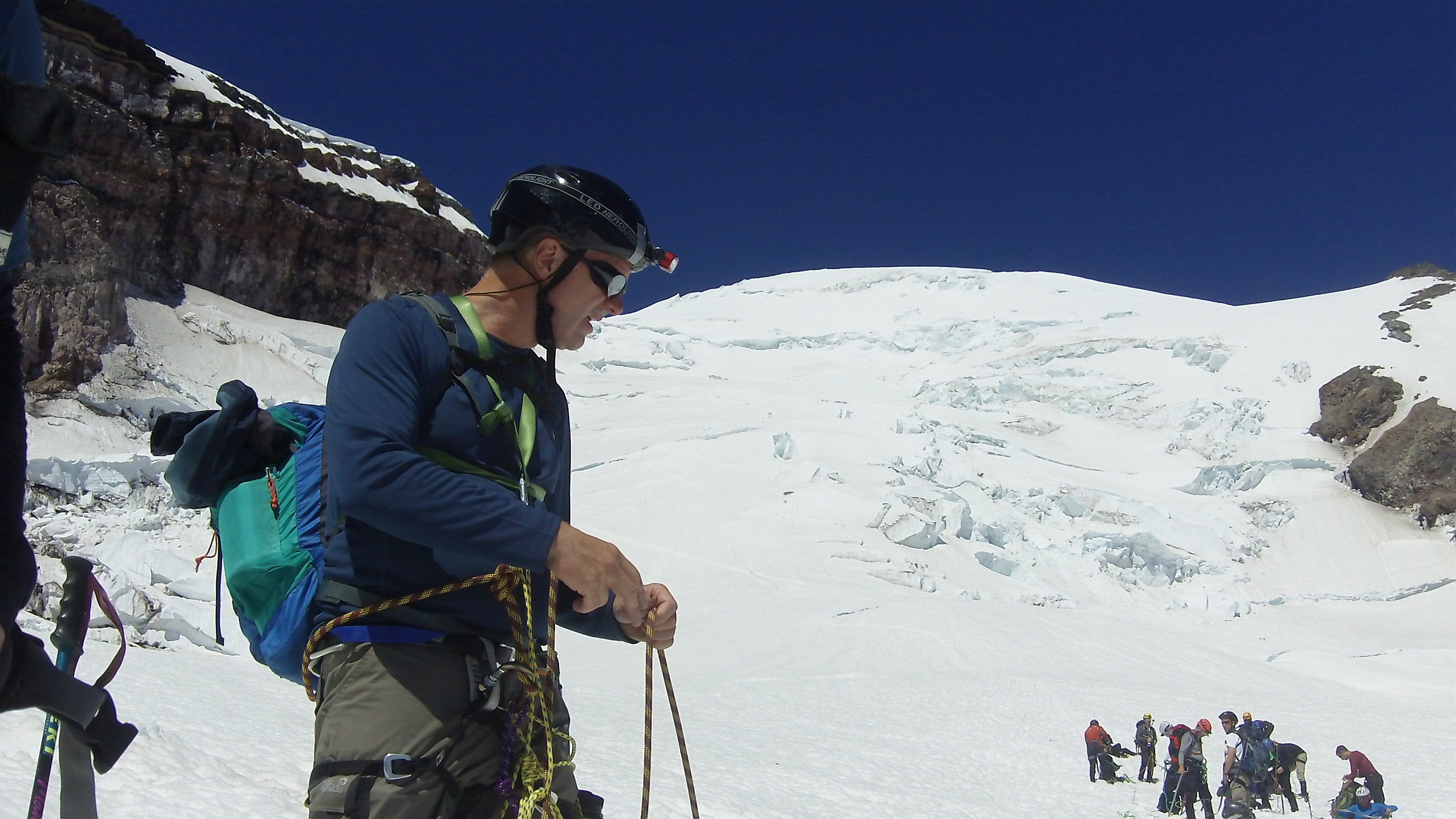
Getting old sneaks up on you, just like everyone says. I find myself reinterpreting my definition of “old” on a yearly basis. Last week I spent three days on Mount Rainier, proving to myself that 57 is not nearly as old as it seemed to me when I was 25. I’ve heard that a summit of Rainier is equivalent to running a marathon, but I have a hard time believing that. Last week’s attempt marks my third time to successfully summit, but I know that I will never in my life be able to run a marathon.
On Wednesday a group of us hiked up to Camp Muir (about 10,000 feet) and set up camp in the lovely little sites that had already been dug out in the snow in order to provide maximum protection from the wind. (If you’ve never camped on snow before, I highly recommend it. The crispness of the air, the frosty surface beneath you and the warmth of your down bag, snuggled up around your face is one of life’s more pure pleasures.) On Thursday, we just lazed around, prepared our ropes and equipment and then tried to grab a little shut-eye (that didn’t work for me) before the start of our ascent to the summit at 11pm. The conditions were mild, so most of us wore rather limited clothing (a wicking layer and a Gore-Tex shell) as we started winding our way up the mountain.
As we reached the ridge of rock known as the Disappointment Cleaver (about 11,500), the winds began to pick up and the temperature dropped. Looking back on the Ingraham Glacier below us, the steady stream of rope teams with headlamps gleaming on the pristine glacial snow looked like a miniature highway – an enchanting sight. Just about that time, the trailing member of our rope team began to feel the severe effects of altitude sickness. This sickness is quite unpredictable, but those who succumb feel like they are ready to divest the entire contents of their stomachs from both ends. Combine that with the tension of unsure footing while roped into a climbing team on a steep, rocky surface along with wind gusts of 50mph that are sapping your core temperature and you can readily recognize, this is not a pleasant experience.
It was on the Cleaver that we met the first rope team that was turning back due to the high winds. It was actually one of the professionally guided teams and I couldn’t foresee that the conditions warranted aborting their attempt, but apparently they thought so. (We discovered later that several teams turned back that day due to the wind conditions.) We continued on past them at a snail’s pace – there were well over 30 teams summiting that day, so the route stacked up like a traffic jam. The temperature grew colder and the winds stronger, but I didn’t want to stop our team to put on extra layers, though I most certainly should have. We just kept pumping down energy jells and pressing on. Eventually at 6:23 AM, nearly frozen (metaphorically speaking) from the wind and from the slowness of the pace, our team crested the crater rim while the wind pelted our faces with bits of snow and ice.
From the rim it’s about a half-mile traverse across the crater to the true summit on the southwest side. At the registry that contains a very normal looking spiral notebook, we recorded our presence. Without much thought I simply wrote: “Steve Pecota, #3, Happy birthday to me.” At that moment, six feet away from me, the most successful American climber in history, Ed Viesturs, knelt on one knee, checking his Blackberry for reception. I didn’t have a clue who he was. Ed Viesturs on the summit of Rainier
During the next 100 yards to the summit, I had to fight the wind to maintain my balance. Fortunately the pathway is broad and not at all dangerous. At the highest point we took the obligatory team photos with Mounts Adams, St. Helens, Hood and Jefferson in the background – a truly awesome sight. (It was an exceptionally clear day! The last time I summited it was so fogged in, line of sight was limited to about 10 feet. In the photo we may as well have been standing on the shore of Lake Washington – one couldn’t tell the difference.)
After that came the long slog downward. I was quite concerned about my knees, but God was gracious and they held up. But by the time we reached Muir, I was exhausted and the thought of the five additional miles down to Paradise, again with a heavy backpack, was less than inspiring. But after a brief respite in the tent that was baking in the noonday sun, my body rose to the challenge. The thought of a pizza beckoning just outside the park boundary spurred us all forward. Ingraham Glacier on the way down toward Muir
As I sat in the warm evening sunshine a few hours later, eating pizza, I thought to myself, “That was a good accomplishment. I’m sure that’s enough of Rainier for me.” But a day later I told the story to various friends and a few of them asked, “Can I go next year?” I found myself already mentally preparing for the next trip.
What is the attraction? It’s hard to put a finger on. Certainly the “growing old” component is one factor. It’s not as if I want to prove to myself that I’m not as old as my driver’s license says that I am. I just want to keep pushing myself beyond what might be considered normal expectations. It seems to me that when we begin to settle for normal, that’s when we begin to succumb to the entropy of aging. That’s something I’d like to resist as long as God makes me able.


 Steve Pecota - a Pastor in Seattle